Timeline renderer
When an agent turn ends, the server summarizes the files it wrote and the commands it ran, and appends a card to the
agent's timeline. The client renders the card and a screen with every turn. This is the agent-hook template.
npx --package paseo-plugin-devkit ppd create ~/code/turn-cards --template agent-hook
cd ~/code/turn-cards && npm install
npm run check && npm test
...
PASS client-eval contributions: addTimelineRenderer, addScreen
...
13 passed, 0 warnings, 0 failed, 0 skipped
Test Files 2 passed (2)
Tests 15 passed | 1 skipped (16)The row
A plugin timeline row has a kind, a version and data. The client validates data with the same schema before
it renders, so the schema lives in shared/. The RPC lets the screen list every summary of an agent.
import { defineRpc } from "@getpaseo/plugin";
import { z } from "zod";

/** Timeline row kind. Bump `SUMMARY_VERSION` when the data shape changes. */
export const SUMMARY_KIND = "turn-summary";
export const SUMMARY_VERSION = 1;

export const summarySchema = z.object({
  agentId: z.string(),
  turnId: z.string().nullable(),
  outcome: z.enum(["completed", "failed", "canceled"]),
  files: z.array(z.string()),
  commands: z.array(z.string()),
  toolCalls: z.number().int(),
  endedAt: z.string(),
});
export type TurnSummary = z.output<typeof summarySchema>;

export const listSummariesRpc = defineRpc({
  name: "summaries.list",
  input: z.object({ agentId: z.string().min(1) }),
  output: z.object({ summaries: z.array(summarySchema) }),
});
The hook
agent.turn_ended carries the whole conversation, so the summary starts after the last user message. Files come
from the detail.filePath of write and edit tool calls; a file a shell command writes is not attributed by the host.
import type { PluginLifecycleEvents } from "@getpaseo/plugin/server";
import type { TurnSummary } from "../shared/turn-summary";

export type TurnEndedEvent = PluginLifecycleEvents["agent.turn_ended"];
type TimelineItem = TurnEndedEvent["timeline"][number];

/** `turn_ended` carries the whole conversation: the turn that just ended starts after the last user message. */
export function currentTurn(timeline: readonly TimelineItem[]): readonly TimelineItem[] {
  let start = 0;
  timeline.forEach((item, index) => {
    if (item.type === "user_message") start = index + 1;
  });
  return timeline.slice(start);
}

/**
 * Files come from write and edit tool calls (`detail.filePath`). Files a shell command writes are not
 * attributed by the host; only the command is known.
 */
export function summarizeTurn(event: TurnEndedEvent, endedAt: Date = new Date()): TurnSummary {
  const files = new Set<string>();
  const commands: string[] = [];
  let toolCalls = 0;
  for (const item of currentTurn(event.timeline)) {
    if (item.type !== "tool_call") continue;
    toolCalls += 1;
    const detail = item.detail;
    if (detail.type === "write" || detail.type === "edit") files.add(detail.filePath);
    else if (detail.type === "shell") commands.push(detail.command);
  }
  return {
    agentId: event.agent.id,
    turnId: event.turnId,
    outcome: event.outcome.kind,
    files: [...files],
    commands,
    toolCalls,
    endedAt: endedAt.toISOString(),
  };
}
Turns without tool calls get no card. The row is appended with paseo.agents.ref(id).timeline.append, and kept in
memory for the RPC:
import { randomUUID } from "node:crypto";
import type { PluginServerContext } from "@getpaseo/plugin/server";
import { summarizeTurn } from "./server/summarize";
import { listSummariesRpc, SUMMARY_KIND, SUMMARY_VERSION, type TurnSummary } from "./shared/turn-summary";

const KEEP_PER_AGENT = 50;

export default function contribute(server: PluginServerContext) {
  const byAgent = new Map<string, TurnSummary[]>();

  const stopListening = server.on("agent.turn_ended", async (event, { paseo }) => {
    const summary = summarizeTurn(event);
    if (summary.toolCalls === 0) return; // plain chat turns get no card
    const kept = [...(byAgent.get(summary.agentId) ?? []), summary].slice(-KEEP_PER_AGENT);
    byAgent.set(summary.agentId, kept);
    await paseo.agents.ref(summary.agentId).timeline.append({
      type: "plugin",
      id: `turn-summary-${randomUUID()}`,
      kind: SUMMARY_KIND,
      version: SUMMARY_VERSION,
      data: summary,
    });
    console.log(`turn summary appended for ${summary.agentId}: ${summary.files.length} file(s), ${summary.commands.length} command(s)`);
  });

  server.handle(listSummariesRpc, ({ agentId }) => ({ summaries: byAgent.get(agentId) ?? [] }));

  return () => {
    stopListening();
  };
}
The card and the screen
Timeline renderers get no navigation props, so the card closes over the client from contribute to open the
screen.
import { Pressable, Text, View } from "react-native";
import type { PluginClientContext, PluginTimelineItemProps } from "@getpaseo/plugin/client";
import type { TurnSummary } from "../shared/turn-summary";

export const SCREEN_ID = "summaries";
const SHOWN_FILES = 5;

function basename(path: string): string {
  return path.split(/[\\/]/).pop() || path;
}

/** Timeline renderers get no navigation props: close over the `client` from `contribute` to open a screen. */
export function makeSummaryCard(client: PluginClientContext) {
  return function SummaryCard({ item, theme, agentId }: PluginTimelineItemProps<TurnSummary>) {
    const c = theme.colors;
    const { files, commands, outcome } = item.data;
    const more = files.length - SHOWN_FILES;
    return (
      <View style={{ borderWidth: 1, borderColor: c.border, borderRadius: 8, padding: 12, gap: 6, backgroundColor: c.surface1 }}>
        <Text style={{ color: c.foreground, fontWeight: "600" }}>
          Turn summary{outcome === "completed" ? "" : ` (${outcome})`}
        </Text>
        <Text style={{ color: c.foregroundMuted }}>
          {files.length} file{files.length === 1 ? "" : "s"} changed, {commands.length} command{commands.length === 1 ? "" : "s"} run
        </Text>
        {files.slice(0, SHOWN_FILES).map((file) => (
          <Text key={file} numberOfLines={1} style={{ color: c.foreground, fontFamily: "monospace", fontSize: 12 }}>
            {basename(file)}
          </Text>
        ))}
        {more > 0 ? <Text style={{ color: c.foregroundMuted, fontSize: 12 }}>and {more} more</Text> : null}
        <Pressable
          accessibilityRole="button"
          accessibilityLabel="All turns"
          onPress={() => client.openScreen({ screenId: SCREEN_ID, params: { agentId } })}
          style={{ alignSelf: "flex-start", borderRadius: 6, paddingHorizontal: 12, paddingVertical: 6, backgroundColor: c.accent }}
        >
          <Text style={{ color: c.accentForeground, fontSize: 13 }}>All turns</Text>
        </Pressable>
      </View>
    );
  };
}import type { PluginClientContext } from "@getpaseo/plugin/client";
import { SummariesScreen } from "./client/summaries-screen";
import { makeSummaryCard, SCREEN_ID } from "./client/summary-card";
import { SUMMARY_KIND, SUMMARY_VERSION, summarySchema } from "./shared/turn-summary";
export default function contribute(client: PluginClientContext) {
const cleanups = [
client.addTimelineRenderer({ kind: SUMMARY_KIND, version: SUMMARY_VERSION, schema: summarySchema, Component: makeSummaryCard(client) }),
client.addScreen({ id: SCREEN_ID, title: "Turn summaries", Component: SummariesScreen }),
];
return () => {
for (const cleanup of cleanups) cleanup();
};
}Run it with the fake agent
mkdir -p /tmp/turn-cards-ws
npx ppd daemon up --fake-agent
npx ppd install
npx ppd paseo -- run --provider fake-agent --cwd /tmp/turn-cards-ws '{"steps":[{"write":{"path":"notes.md","content":"hi"}},{"say":"done"}]}'
npx ppd paseo -- plugin logs turn-cards
npx ppd web --shot out/card.png
The plugin log shows the hook ran:
turn summary appended for 544f3a69-ae2b-465c-af06-6d3183b8fbf9: 1 file(s), 0 command(s)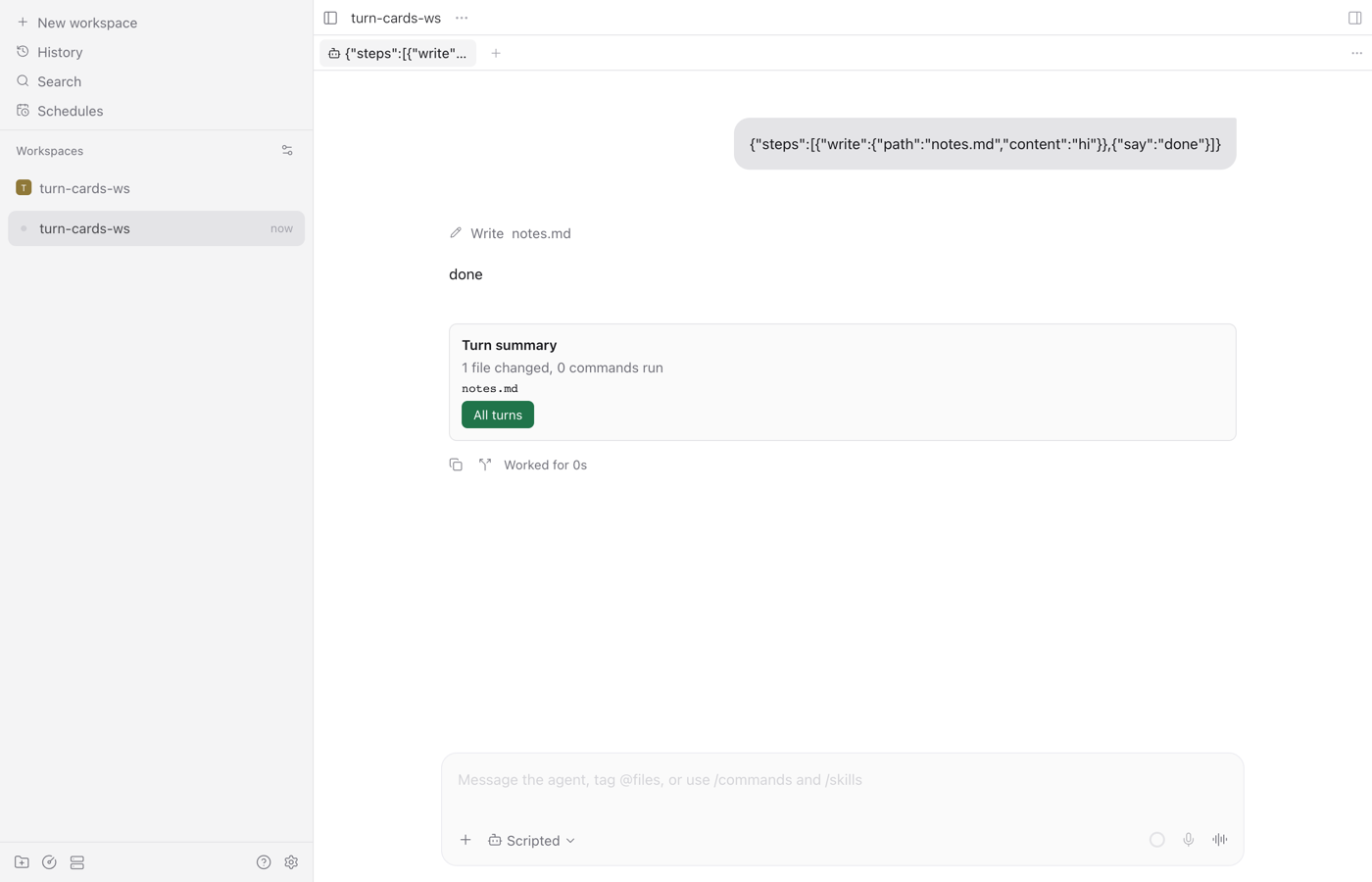
Test it
paseo logs does not show plugin rows; agentTimeline reads the canonical timeline, plugin rows included. Hooks
run asynchronously, so poll:
import { agentTimeline, pluginRows, runFakeAgentTurn, sendFakeAgentTurn } from "paseo-plugin-devkit";

const turn = runFakeAgentTurn(
  [
    { write: { path: "notes.md", content: "first\n" } },
    { bash: { command: "npm test", output: "ok", exitCode: 0 } },
    { say: "Done." },
  ],
  { cwd: workspace },
);
// waitFor polls until the probe returns something other than null (see the test linked below).
const [card] = await waitFor(() => {
  const rows = pluginRows(agentTimeline(turn.agentId), "turn-summary");
  return rows.length ? rows : null;
});
expect(card).toMatchObject({ data: { outcome: "completed", files: [join(workspace, "notes.md")], commands: ["npm test"] } });

// A chat-only turn gets no card.
sendFakeAgentTurn(turn.agentId, [{ say: "just chatting" }]);
The devkit's test/create-e2e.test.ts runs
this against a dev daemon it starts and stops itself, with waitFor and a failing turn.
The fake agent emits the canonical write, edit and shell items that Paseo maps real tools onto. Real adapters
can differ in the details, so run a hook once with a real agent before you ship it.